Local ML · Images
Mochi Tagger
Local ML-powered image tagging, with a review loop that keeps the final labels in your hands.
Working entry Sample availability; cover studies and development stages are illustrative.
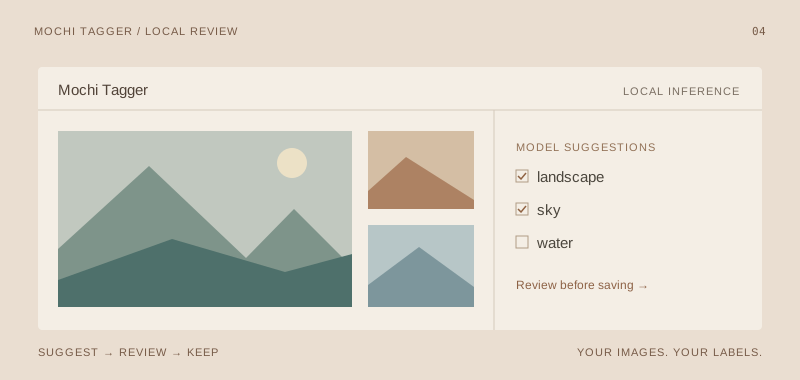
Let the model suggest. Keep the decision local.
Mochi Tagger is a local ML-powered image tagging application. The useful unit of work is an image and the labels a person chooses to keep. This sample product direction gives model suggestions a place beside the image, then makes review and correction part of the workflow. The sample workflow follows intake, inference, review, and saved labels, keeping model suggestions separate from a person’s choices.
A review loop, not a wall of labels
Suggestions stay editable
A predicted tag is a proposal. Accepting, removing, and correcting labels should feel like ordinary editing, with a clear distinction between model suggestions and a person's choices.
Keep visual context close
The image should remain visible while labels are reviewed. A compact contact sheet can support movement through a collection without turning the task into a separate metadata form.
Respect the local workflow
Local inference is the project's foundation. The proposed workflow should make selected files and review state clear, and avoid making a hosted account part of the tagging loop.
Useful uncertainty
A label can be plausible without being useful. The proposed review loop leaves space for that uncertainty: suggestions are visible, editable, and separate from labels a person has chosen.
A first workflow study would follow a small collection from intake through inference to review. Before adding more controls, it should answer a basic question: can someone tell what has changed, what still needs attention, and what will be saved?
The workflow boundaries
- Core approach
- Local machine-learning inference
- Product focus
- Image tagging and human review
- Suggested boundaries
- Image intake → inference → review → saved labels
- Open decisions
- Model, implementation stack, and label storage
An example development path
Illustrative stages, from later explorations to foundations.
Collection workflow
Explore review progress and repeatable navigation through a local collection.
Suggestion review
Study accepting, correcting, and saving suggested labels without losing the image context.
Local inference
Establish a sample path from an image to model suggestions, with model and storage choices still open.